Ryan arrived at his ex-wife’s wedding wearing an expensive suit and a cruel smile. He came to laugh at the man she had chosen—but when he saw the groom’s face, the shame hit him harder than any insult.
Ryan Collins heard about Lily’s wedding at a business dinner.
An old friend mentioned it casually, between a glass of wine and a laugh.
“Do you remember Lily Parker? She’s getting married next Saturday.”
Ryan looked up from his plate. “Lily?”
“Yes. To a construction worker, apparently. Simple guy. Not much money.”
Ryan laughed before he could stop himself.
Years earlier, Lily had loved him when he had nothing but ambition and borrowed textbooks. She worked evenings at a small hotel while he studied economics and spoke endlessly about the life he planned to build. She believed in him before anyone else did.
And when success finally began to open its doors, Ryan decided she no longer looked like the woman who belonged beside him.
He left her for Amanda Blake, the elegant daughter of his company’s director.
Amanda had the right family, the right clothes, the right contacts. On paper, Ryan had chosen perfectly.
But fifteen years later, he lived in a luxury apartment, drove a BMW, held a high title, and still felt like a guest in his own home. Amanda reminded him often that her father had made his career possible.
“If it weren’t for us,” she once said, “you would still be nobody.”
Ryan hated hearing it.
But he hated more that it was partly true.
So when he heard Lily was marrying a poor man, something small and bitter woke inside him. He decided to attend the wedding, not to congratulate her, but to see her regret.
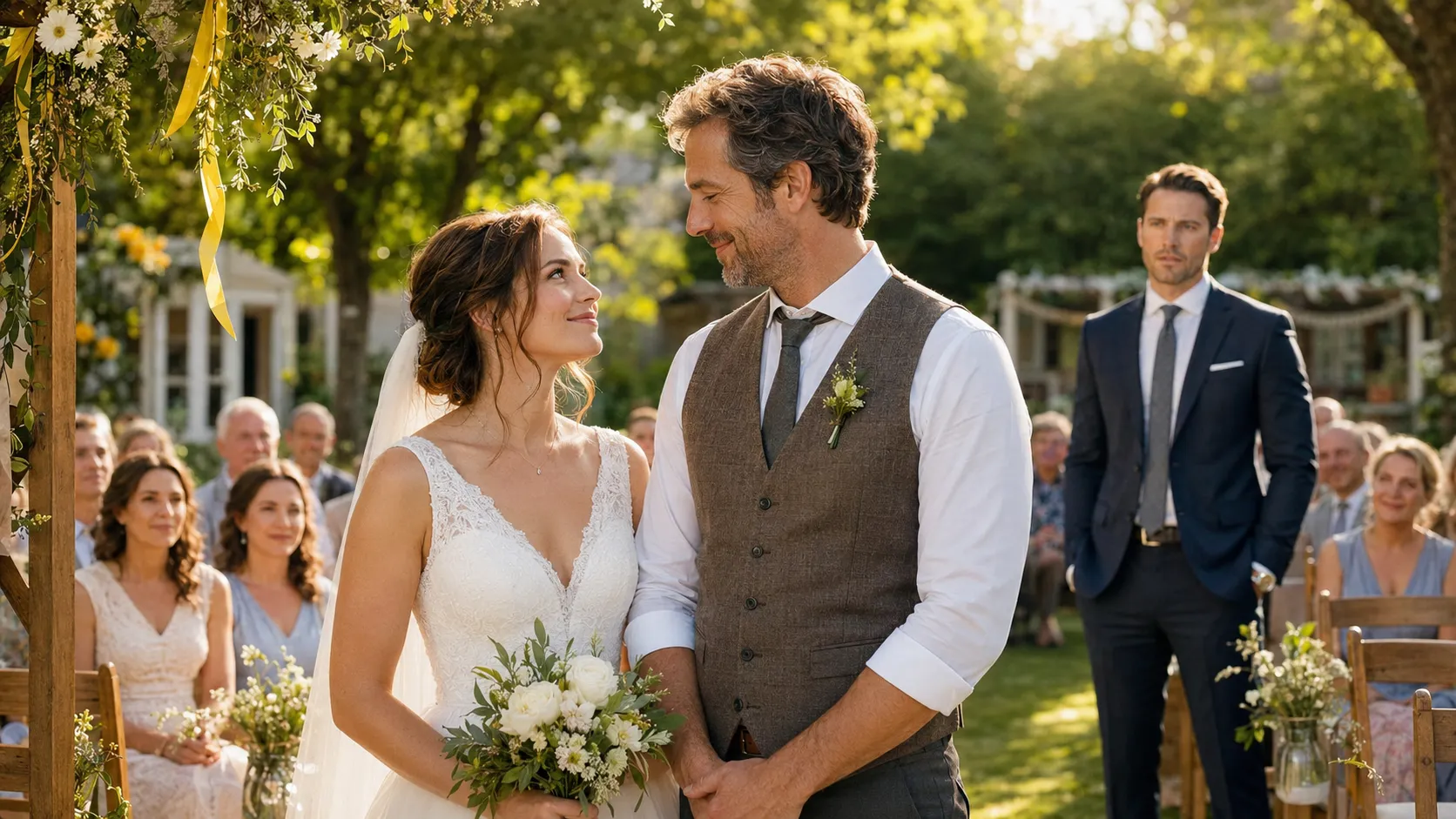
On Saturday, Ryan drove to a small town outside Sacramento. The wedding was held in a garden behind a modest family house. There were wooden chairs, wildflowers in jars, yellow ribbons tied to branches, and old women arranging plates of food under a white tent.
It was not grand.
But it was warm.
Ryan stepped out of his car in a tailored suit and expensive watch. A few guests turned to look at him. He enjoyed it. He wanted them to see the difference between him and the life Lily had apparently chosen.
Then he saw the groom.
The man stood near the altar in a simple vest, leaning slightly on one prosthetic leg.
Ryan’s smile died.
“Mark?” he whispered.
Mark Dawson.
His university roommate.
The same Mark who had once lost a leg in a terrible accident and returned to campus with a quiet smile, refusing pity. The same Mark who cooked when Ryan forgot to eat, helped him prepare for exams, and lent him money without ever making him feel small.
Ryan had called him a friend.
But in truth, he had treated Mark like background noise in the story of his own ambition.
After graduation, Ryan moved upward and never looked back. Mark became a construction supervisor, stayed close to his family, and built a life with the kind of patience Ryan had always mistaken for weakness.
Now Mark was standing at the altar, waiting for Lily.
Then she appeared.
Ryan had prepared himself to see regret in her face.
He saw none.
Lily walked down the garden path in a simple white dress, her eyes shining, her smile steady and peaceful. When she reached Mark, he took her hand with such care that Ryan felt something inside him tighten.
An elderly guest near Ryan whispered, “Mark built their little house himself. Took him five years. Every board, every window. He said Lily deserved a home made by hands that loved her.”
Another replied, “And she never once looked at him as if he was less than anyone.”
Ryan looked at Mark again.
He saw the limp.
But he also saw the way Lily stood beside him without shame, without doubt, without calculation. She was proud of him. Proud to hold his hand. Proud to build a life with him.
Ryan suddenly remembered the way Lily used to look at him.
Before he taught her that love was not enough.
During the vows, Mark’s voice shook once.
“I cannot promise you riches,” he said to Lily. “But I promise you will never have to wonder whether you are loved.”
Lily cried.
So did half the garden.
Ryan stood in the back, silent and ruined.
He had come to laugh at a poor man.
Instead, he saw a husband.
He had come to prove Lily had fallen.
Instead, he saw that she had chosen peace.
After the ceremony, Lily noticed him.
For a moment, surprise crossed her face. Then she smiled gently, not with longing, not with anger, but with the calm kindness people give to a chapter that has already closed.
“Ryan,” she said. “I hope you’re well.”
That was all.
No bitterness. No performance. No secret wound waiting for him.
Just peace.
Mark stepped beside her and held out his hand.
“Good to see you again,” he said.
Ryan shook it and could barely look him in the eye.
He wanted to apologize for years of arrogance, for disappearing, for thinking love had less value than status. But the words came too late and too small.
So he only said, “Congratulations.”
On the drive home, Ryan did not turn on the radio.
The silence was too honest.
When he reached his apartment, Amanda was not there. The rooms were spotless, expensive, and cold. His watch lay on the table. His suit jacket fell to the floor.
For the first time in years, Ryan sat down and cried.
Not because Lily had married someone else.
Because she had found what he had thrown away.
Not because Mark had won.
Because Mark had never been playing the shallow game Ryan had spent his life trying to win.
That night, Ryan looked around at the things he once believed proved his worth.
The car keys.
The glass walls.
The designer furniture.
The title on his office door.
None of it could hold his hand.
None of it could forgive him.
None of it could look at him the way Lily had looked at Mark.
From that day on, Ryan changed slowly.
He stopped measuring people by salary, clothing, or status. He stopped laughing at simple lives. He stopped using expensive things to hide the fact that he was lonely.
He did not try to win Lily back.
He knew he had lost that right long ago.
But he began trying to become the kind of man he should have been when someone good had loved him.
Years later, whenever Ryan saw a couple walking hand in hand, he remembered that garden.
A simple wedding.
A groom with a limp.
A bride with peace in her eyes.
And the lesson that arrived too late, but not too late to save what remained of him:
A man’s worth is not measured by what he owns.
It is measured by how safely someone can love him.