Everyone thought Henry was foolish for choosing the oldest, weakest dog in the shelter. But that night, when Shadow began digging beneath the old oak tree, the lonely widower discovered the dog had not come to be saved—he had come to save him.
Henry Parker walked into the county animal shelter with five dollars in his pocket and grief in his bones.
At seventy-eight, he moved slowly now. His hands trembled. His coat was thin at the elbows. Since his wife May died five winters earlier, he had lived in the same small house, sat in the same porch chair, and listened to the same silence every evening.
“I heard you have an old dog,” he told the volunteer. “The one no one wants.”
The girl’s face softened. “Sir, he’s blind in one eye. He can barely walk. The vet says he may not have long.”
Henry placed the wrinkled bill on the counter.
“Then he shouldn’t spend what time he has left alone.”
They brought out an old German Shepherd, gray around the muzzle, ribs faint under thinning fur. He did not bark. He did not wag. He simply limped forward and rested his head against Henry’s knee.
Henry closed his eyes.
“I know, boy,” he whispered. “I miss someone too.”
He named him Shadow.
Life did not become grand after that. It became gentle.
Henry and Shadow moved through the days at the same slow pace. They ate breakfast together. They sat on the porch at dusk. Henry spoke to him about May, about the garden she once loved, about the way she used to hum while folding towels.
Shadow listened like he understood every word.
Neighbors noticed the change.
Henry’s curtains opened more often. His porch light came on again. Sometimes, if the evening was quiet enough, people saw him smiling with one hand resting on the old dog’s back.
Then the storm came.
Thunder rolled over the town, and rain slapped hard against the windows. Henry was locking the back door when Shadow suddenly lifted his head and began whining.
“Shadow?” Henry called. “Come here, boy.”
But the dog pushed through the half-open door and limped into the yard.
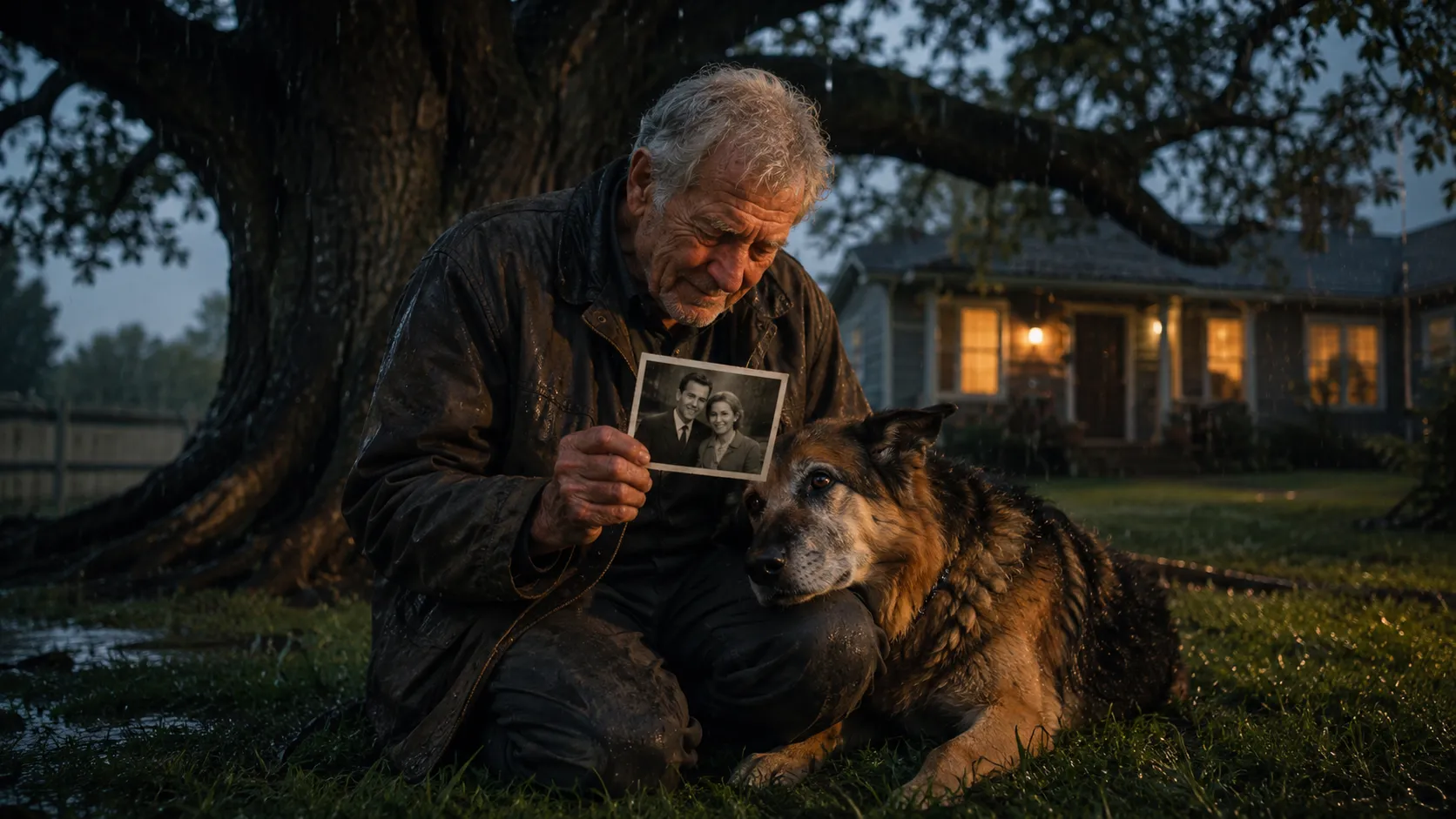
Henry grabbed his cane and followed, rain soaking through his shirt. Shadow was under the old oak tree, digging with a desperation Henry had never seen. His paws tore at the mud between the roots.
“Stop,” Henry begged. “You’ll hurt yourself.”
Shadow kept digging.
Lightning flashed.
Henry saw metal in the dirt.
He knelt with a groan and brushed mud away until his fingers touched a small rusted box. The lock had broken long ago. Inside was a photograph wrapped in oilcloth.
Henry unfolded it with shaking hands.
It was him and May, forty years younger, standing beneath that same oak tree on the day they bought the house. May was laughing. Henry’s arm was around her waist. On the back, in her handwriting, were the words:
For Henry, when he forgets he was loved.
His breath broke.
He remembered now.
May had buried little memory boxes around the garden during her last year, smiling whenever he asked what she was doing.
“One day,” she had said, “you’ll need to find me again.”
Henry pressed the photograph to his chest.
Shadow rested his wet head against Henry’s knee.
And in that storm, under the tree where his life had once been full, Henry understood.
He had thought he rescued a dying dog.
But Shadow had brought him back to the part of himself that had stopped living when May left.
That night, Henry sat on the porch until the rain passed, one hand on the rusted box, the other on Shadow’s head.
For the first time in years, the house did not feel empty.
The next morning, Henry opened the door to let Shadow out.
The dog’s bed was empty.
Panic seized him.
He followed faint paw prints through the wet grass, past the road, up the hill toward the cemetery. By the time he reached May’s grave, his lungs were burning.
Shadow was lying beside the headstone.
Peaceful.
Still.
Between his paws was a single yellow wildflower, the kind May used to pick from the roadside because she said bought flowers had no adventure in them.
Henry fell to his knees.
“Oh, boy,” he whispered, pulling the old dog close. “You brought me back to her.”
The town gathered quietly that evening. No one made a speech. They buried Shadow near the oak tree, where May’s photograph had waited beneath the roots.
Weeks later, people saw Henry walking to the cemetery every Sunday with two flowers: one for May, one for Shadow.
He still missed them.
But he was no longer lost.
Because sometimes love does not return loudly.
Sometimes it comes home old, tired, gray around the muzzle, and asks for nothing but a warm place to rest.
And sometimes, the soul you think you are saving is the one sent to lead you back to your own.