Eleanor had spent years believing the town’s cruel whispers about her body and her worth. But when a widowed cowboy asked for help with his five children, the answer she gave made the whole street go silent.
Eleanor Briggs had learned to walk through town with her eyes lowered.
In Willow Creek, people smiled politely to your face and sharpened their opinions behind your back. They called her kind, useful, dependable.
But never beautiful.
She was the curvy seamstress who lived above the tailor shop, the woman men passed over, the woman mothers pitied, the woman girls were warned not to become.
So when Thomas Hale asked to meet her outside the general store, Eleanor already knew what the town was thinking.
Thomas was a rancher, a widower, and the father of five children. Since his wife died the previous winter, he had been trying to run a ranch, mend clothes, cook meals, settle fights, soothe fevers, and keep grief from swallowing the house whole.
The town had offered advice.
Marry a widow.
Hire a young girl.
Send the children to relatives.
Then someone suggested Eleanor.
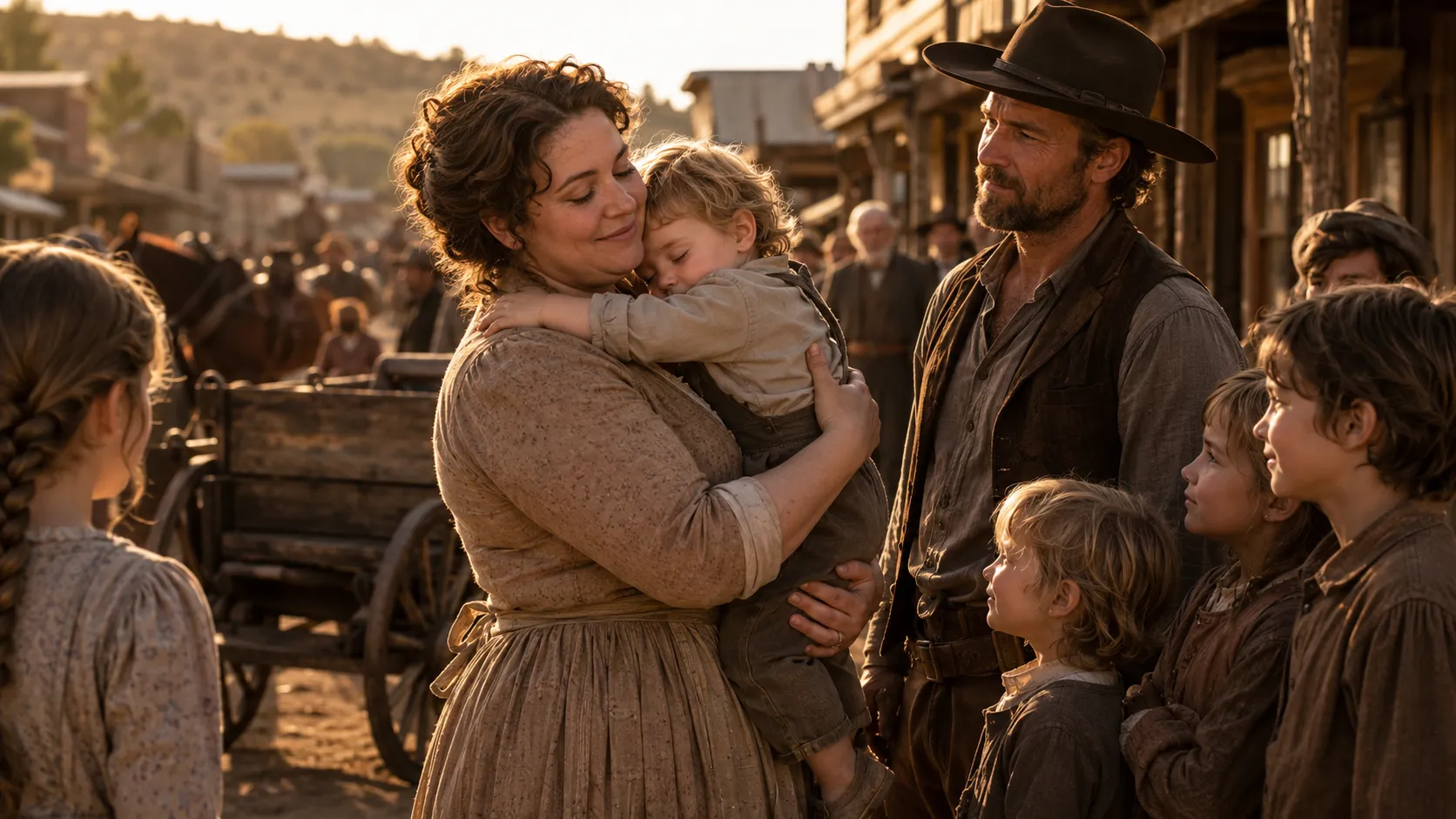
Now Thomas stood before her in the dusty street with four children gathered around his boots and an infant sleeping in a basket in the wagon.
The oldest girl held a cloth doll. Two boys watched Eleanor with curious eyes. A toddler clung to Thomas’s shirt, half asleep and thumb in mouth.
Eleanor looked at them and felt her heart ache before she could stop it.
Thomas cleared his throat. “Miss Briggs, I appreciate you coming.”
She folded her hands carefully.
“Mr. Hale,” she said, “before you say anything more, there is something you should understand.”
Thomas waited.
Eleanor took a slow breath.
“I am not fit for any man.”
The street quieted.
A woman near the store turned her head. A man pretending to fix a crate stopped moving.
Eleanor kept her voice steady, though every word scraped against years of shame.
“I know what people say. I know what they see when I walk by. Too large. Too plain. Too awkward. Too much of everything. I have never had a husband, and I do not expect I ever will.”
Thomas said nothing.
Eleanor looked at the children.
“But I can love your children.”
The silence that followed reached all the way down the street.
Thomas lowered his eyes to his daughter. “Clara, what do you think?”
The little girl studied Eleanor seriously.
“Do you know how to braid hair?”
Eleanor blinked. “Yes.”
Clara nodded. “That’s good.”
One of the boys asked, “Can you make pie?”
“Yes.”
The smaller boy stepped closer. “Can you read stories?”
Eleanor’s throat tightened.
“I love reading stories.”
Then the toddler on Thomas’s hip reached for her.
Eleanor froze.
The little boy leaned out with both arms, and instinct took over. She caught him gently. He settled against her shoulder as if he had known her all his life.
Thomas stared.
The crowd stared too.
The child yawned and fell asleep against the woman the town had spent years dismissing.
Thomas rubbed the back of his neck.
“Well,” he said quietly, “that answers one question.”
Eleanor looked down at the sleeping boy.
“What’s his name?”
“Samuel.”
She held him carefully, as if he were something sacred.
Thomas’s voice softened. “Would you like to see the ranch?”
The Hale ranch sat five miles outside town. The land was beautiful, but the house told the truth: dishes in the sink, boots at the door, laundry half folded, toys under chairs, grief in every corner.
Eleanor did not criticize.
She rolled up her sleeves.
“Where do you keep the flour?”
Thomas blinked. “Flour?”
“If five children live here,” she said, “someone should be baking.”
Within an hour, the kitchen smelled of fresh bread. Clara stood proudly beside the mixing bowl. The boys stopped fighting long enough to watch. Samuel slept in his cradle. For the first time in months, Thomas stood in his own doorway and did not feel like he was drowning.
That evening, Eleanor read aloud from a dusty book while the children gathered around her feet.
Even Thomas sat down to listen.
When the story ended, Clara whispered, “Will you stay tomorrow?”
Eleanor looked at Thomas.
He did not command. He did not pity. He only waited.
“Only if you want to,” he said.
Eleanor looked around the worn room, at the tired chairs, the sleeping baby, the hopeful faces.
“I think I would like that,” she said.
Spring turned into summer.
The Hale ranch changed.
The garden grew. The children laughed more. Clean shirts hung on the line. Bread cooled on the windowsill. Stories returned to the evenings.
And slowly, the town changed too.
Not because people became kinder overnight.
But because the children refused to let them be cruel.
“My mama Eleanor made pie.”
“My mama Eleanor fixed my shirt.”
“My mama Eleanor says brave people tell the truth.”
Each time Eleanor heard it, something inside her healed a little.
One afternoon, Clara found her in the garden.
“Are you really not fit for any man?” the girl asked.
Eleanor paused. “Why do you ask?”
Clara nodded toward the barn.
Thomas stood there watching them, his hat in his hands and a quiet look on his face Eleanor had never seen from any man before.
Respect.
Gratitude.
Something gentler than both.
“Because Papa doesn’t look like he agrees,” Clara said.
Eleanor turned away before the child could see her tears.
That evening, after the children were asleep, Thomas found her on the porch.
“My wife once told me a good heart matters more than a pretty face,” he said. “I thought I understood her then. I don’t think I truly did until now.”
Eleanor whispered, “People will talk.”
“They already did,” Thomas said. “And they were wrong.”
For the first time in her life, Eleanor wondered if maybe she had been wrong too.
Maybe she was not meant for every man.
Maybe she had never needed to be.
Because in a little ranch house full of noise, flour, muddy boots, bedtime stories, and children who reached for her without shame, Eleanor Briggs had finally found the place where love did not ask her to become smaller.
It simply made room.