Ethan only wanted to ask why the millionaire was wearing his father’s watch. But when he said one name in the hotel lobby, the rich man froze—because that watch carried a debt he had never been able to repay.
The boy did not belong in the Grand Meridian Hotel.
Everyone could see it.
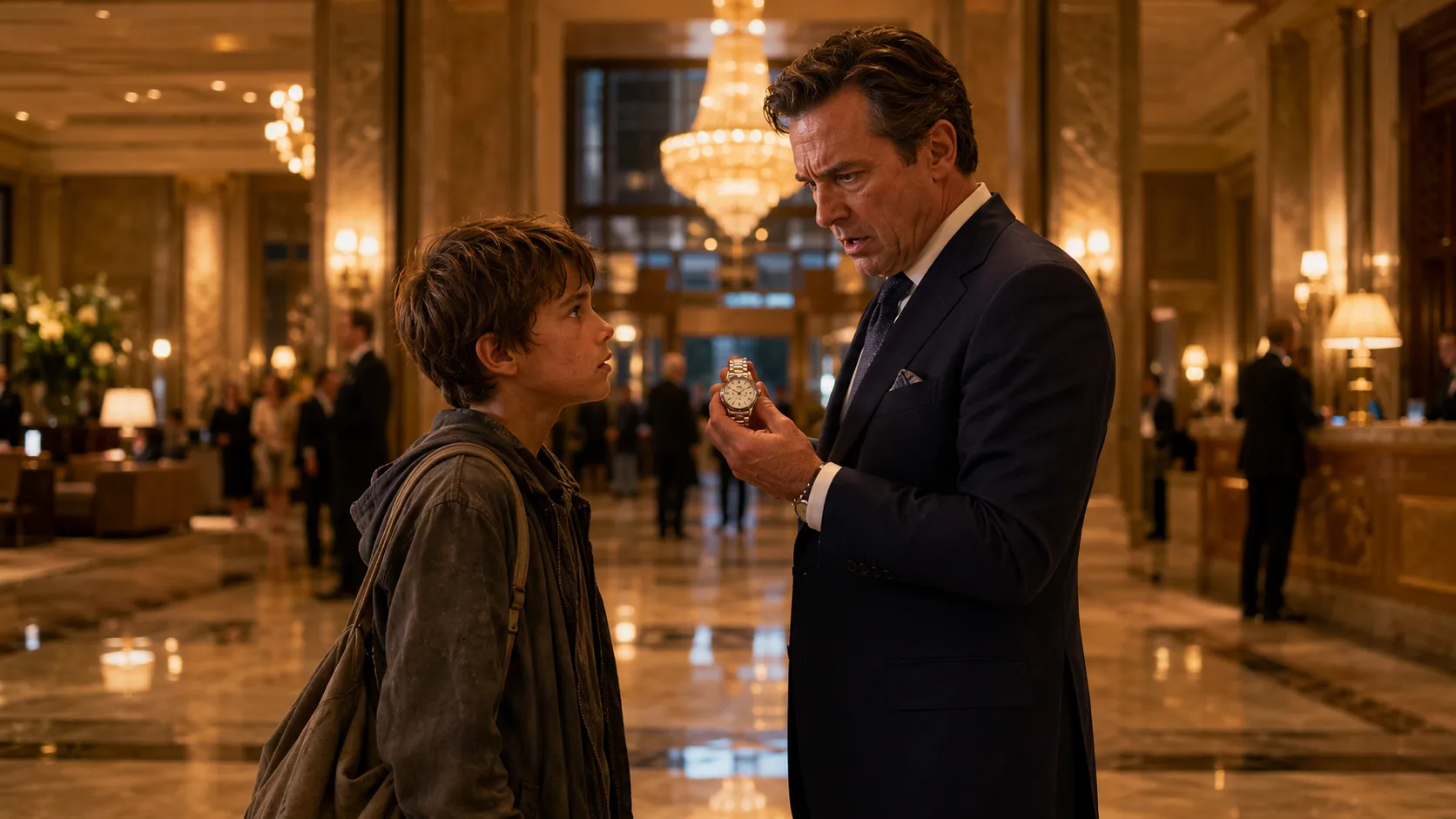
His jacket was too thin, his shoes were dusty, and the cloth bag on his shoulder looked older than he was. In a lobby filled with crystal lights, polished marble, and guests who smelled of money, he stood near the revolving doors as if he were deciding whether courage was worth humiliation.
A security guard had already started toward him.
Then the boy saw the watch.
Across the lobby, a man in a navy suit stood near the concierge desk, speaking quietly into his phone. He looked rich in the effortless way some men do: calm posture, polished shoes, expensive haircut. But on his wrist was a silver watch with a faint scratch along the rim.
The boy’s breath caught.
He crossed the lobby before fear could stop him.
“Sir,” he said softly, tugging the man’s coat.
The millionaire turned, irritated.
Then he saw the child.
“Where did you get that watch?” the boy asked. “My dad had the same one.”
The man’s face changed.
Slowly, he covered the watch with his hand.
“What did you say?”
“My dad had the same watch,” the boy repeated. “He wore it every day.”
The lobby seemed to lose its sound.
The man bent closer.
“What was your father’s name?”
The boy swallowed. “Scott Cross.”
The millionaire went completely still.
Scott.
He had not heard that name in years.
Fifteen years earlier, Gabriel Ward had been a homeless teenager sleeping behind bus stations, stealing warmth from laundromats, and eating whatever strangers left behind. No family. No money. No future.
One rainy night, he collapsed outside a small repair garage.
Scott Cross found him there.
Scott was not wealthy. He was a mechanic with rough hands, tired eyes, and a laugh that made people feel less ashamed of needing help. He gave Gabriel food first. Then a broom. Then work. Then trust.
“You are not what life did to you,” Scott used to say. “You are what you decide to become next.”
Scott taught him how to fix engines, how to arrive on time, how to look people in the eye, and how to stop thinking of himself as trash left by the world.
When Gabriel finally left town to chase a better future, Scott took off his silver watch and pressed it into his hand.
“You’ll need this more than I do,” he said. “Time is your greatest investment.”
Gabriel promised he would return rich enough to repay him.
But by the time success came, Scott was dead.
A sudden illness. No warning. No goodbye.
At the funeral, Gabriel stood in the back, wearing the watch, and made one quiet promise: if he ever found Scott’s family, he would give back everything Scott had given him.
Now Scott’s son was standing in front of him.
“What’s your name?” Gabriel asked.
“Ethan.”
“Where is your mother?”
Ethan looked down. “She works two jobs. We lost our house after Dad got sick. Mom says we’ll be okay, but she cries when she thinks I’m asleep.”
Gabriel closed his eyes.
The words hurt more than any accusation.
He removed the watch and turned it over. On the back, the engraving was still there.
To Scott.
For always being on time.
— Dad
Ethan stared at it.
“That’s his,” he whispered.
Gabriel knelt in the middle of the hotel lobby, not caring who watched.
“No,” he said, his voice breaking. “He gave it to me when I had nothing. And I have worn it every day because your father was the first man who believed I could become someone.”
Ethan’s eyes filled with tears.
“Then why didn’t you come back?”
The question struck Gabriel harder than shame.
“Because I thought I had time.”
For a long moment, neither of them moved.
Then Gabriel pulled the boy into his arms.
It was not charity.
It was grief.
It was gratitude.
It was a promise finally finding its way home.
Within days, Gabriel met Ethan’s mother, Clara. At first, she did not trust him. Life had taught her that rich men rarely appeared without wanting something.
But when Gabriel spoke about Scott’s garage, his old jokes, the way he hummed while working on engines, Clara began to cry.
“You really knew him,” she whispered.
“I owe him everything,” Gabriel said. “And I am sorry I arrived so late.”
He paid their debts, helped them move into a safe apartment, and created an education fund for Ethan. But he did not simply write a check and disappear.
Every Saturday, Gabriel picked Ethan up and took him to the old garage where Scott had once saved him. Together, they cleaned the windows, repaired the lift, and reopened it as a training workshop for young people who needed a second chance.
On Ethan’s eighteenth birthday, Gabriel handed him a small velvet box.
Inside was the silver watch.
Ethan traced the scratch along the rim with one finger.
“It belongs to you now,” Gabriel said. “Your father gave me time when I had none. Now I’m giving it back to his son.”
Ethan looked up. “Would he be proud of you?”
Gabriel smiled through tears.
“I hope so.”
Years later, people still told the story of the poor boy in the hotel lobby and the millionaire who fell silent over a watch.
But the real miracle was not the money.
It was that one act of kindness had survived across years, grief, poverty, and success.
Scott never lived to see the life he changed.
But through his son, and through the man he once rescued from the rain, his kindness kept moving forward.
Because the greatest inheritance is not always what a father leaves behind.
Sometimes it is the goodness he planted in someone else.