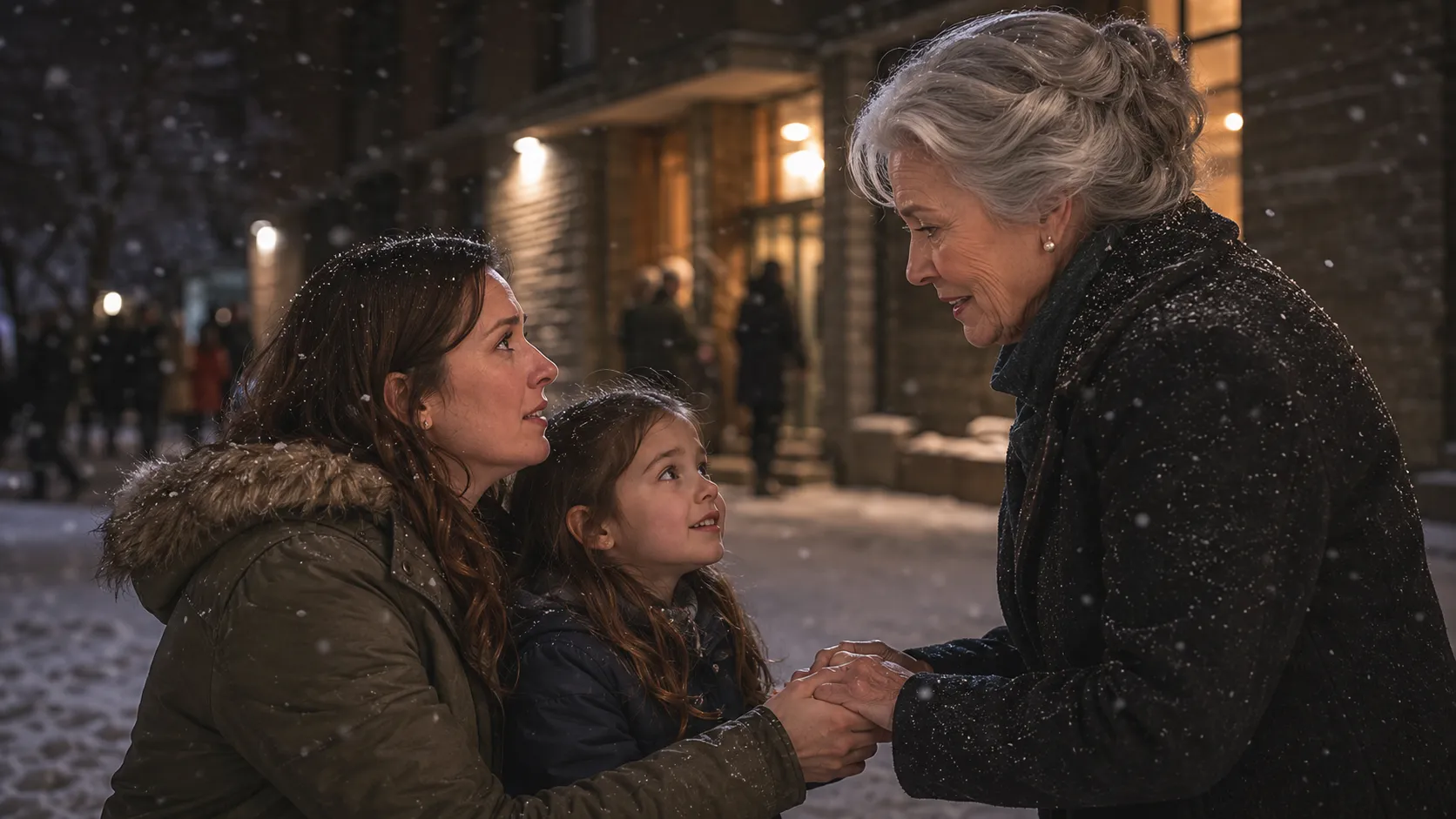
Rachel was standing in line for shelter soup with her six-year-old daughter when her multimillionaire grandmother stepped out of a Rolls-Royce and froze. “Why don’t you live in the mansion I left you?” she asked—and three days later, Rachel’s parents learned that the lie they had buried was coming home.
Rachel Morgan was holding her daughter’s hand outside St. Andrew’s Outreach Shelter when the snow began to fall harder.
Sophie was only six. Her little fingers were stiff from the cold, and her coat was too thin for a December night. Rachel kept rubbing the child’s hands between her own, pretending warmth could be created by love alone.
“Mommy,” Sophie whispered, “will they have bread too?”
Rachel swallowed.
“I think so, sweetheart.”
The line moved slowly. Ahead of them, people waited for soup, blankets, and a few hours indoors. Rachel had lost her job at the grocery store three weeks earlier. Then the landlord changed the locks on the tiny room she and Sophie had rented.
She had called her parents.
Her mother sighed and said, “You made your choices.”
Her father told her they could not help.
That same week, Rachel saw photos online of their newly remodeled kitchen.
So she stopped calling.
Then a black Rolls-Royce pulled up beside the shelter.
An elderly woman stepped out in a fur coat and pearls, surrounded by assistants carrying umbrellas. She had come to donate, Rachel assumed. People like that often arrived for photographs, handed over checks, and left before the cold entered their bones.
But the woman looked across the line and suddenly stopped.
Her face went pale.
“Rachel?”
Rachel’s breath caught.
“Grandma Evelyn?”
Evelyn Harrington, her great-grandmother, had spent years living between London, Paris, and New York. Rachel had not seen her since she was a teenager. Her parents had always said Evelyn had “lost interest” in her.
Now the old woman rushed through the snow, ignoring the slush on her expensive shoes.
“My God,” Evelyn whispered, pulling Rachel and Sophie into her arms. “Why are you standing here? Why is my great-granddaughter waiting for soup?”
Rachel broke then.
“We don’t have a home.”
Evelyn pulled back slowly. The warmth in her eyes turned sharp.
“What do you mean you don’t have a home?” she asked. “Where is the Willowcrest mansion?”
Rachel stared at her. “What mansion?”
The silence between them was colder than the snow.
Evelyn’s voice dropped. “The house I transferred to you and Sophie eight years ago. Fully paid. Legally documented. I left it in trust so no one could take it from you.”
Rachel felt the ground disappear beneath her.
“I never knew.”
Evelyn turned to one of her assistants. “Get my attorney. Now.”
Three days later, Rachel walked into her parents’ anniversary party holding Sophie’s hand.
The ballroom of their country club glittered with crystal glasses, white roses, and expensive music. Her parents stood near the cake, smiling for guests who believed they were generous, respectable people.
Then they saw Rachel.
Then they saw Evelyn.
Her father’s face drained of color.
“Mother,” he said carefully. “What is this?”
Evelyn placed a thick folder on the table.
“This is the deed to the Willowcrest house,” she said. “This is the trust record. This is the correspondence showing you intercepted every legal notice meant for Rachel. And this is the evidence that you used the property’s rental income for yourselves while your granddaughter and great-granddaughter stood in a shelter line.”
The room went silent.
Rachel’s mother gripped the back of a chair.
“It was complicated,” she whispered.
“No,” Evelyn said. “It was theft.”
Her father tried to smile at the guests. “We were managing things until Rachel became responsible enough.”
Rachel looked at him then.
“I was homeless with your granddaughter. You knew.”
No one defended him.
Not the relatives. Not the friends. Not the business partners holding champagne.
Evelyn opened the folder again.
“As of this morning, Rachel has full access to her home, her accounts, and every dollar you took. My attorneys have already begun proceedings.”
Rachel’s mother began to cry.
Evelyn did not soften.
“You let a child sleep in the cold while living off the roof meant to protect her.”
Sophie tugged Rachel’s sleeve.
“Mommy,” she whispered, “do we really have a house?”
Rachel knelt in front of her daughter. Tears ran down her face.
“Yes, baby,” she said. “We do.”
That night, Evelyn drove them to Willowcrest Avenue.
The mansion was quiet, with ivy along the stone walls and lamps glowing in the windows. Rachel stood at the front steps, afraid to touch the door of a life she had been denied.
Evelyn placed the key in her hand.
“This was always yours.”
Inside, Sophie ran from room to room, laughing for the first time in weeks. Rachel followed slowly, touching the staircase, the fireplace, the kitchen counter—proof that the world had not only been cruel. It had also been stolen.
In the nursery upstairs, she found a wrapped gift Evelyn had placed there years before.
A silver frame.
Inside it was a photo of Rachel as a child, sitting on Evelyn’s lap.
On the back, written in Evelyn’s careful hand, were the words:
For Rachel, so she will always have a place to come home to.
Rachel held the frame against her chest and cried.
The next morning, Sophie woke in a real bed under a warm blanket.
“Mommy,” she said sleepily, “are we still allowed to stay?”
Rachel sat beside her and brushed the hair from her face.
“Yes,” she whispered. “No one can send us away again.”
For years, Rachel had believed she had been abandoned.
But the truth was worse, and better.
She had been lied to.
And now, at last, the door that was always meant for her had opened.